
Anna Catherine Vida doesn't do social media. Her studio—a converted granary in rural Somerset—has no Wi-Fi, just a wood-fired kiln and a wall of unglazed test tiles. I visited last autumn, and she handed me a cup she'd thrown that morning. 'Feel the weight,' she said. 'Most potters make cups too heavy. They forget the lip.' That single detail—the lip—explains why her work sits in the V&A's permanent collection while countless shinier names fade. Vida's ceramics aren't designed for Instagram. They're designed for the hand.Born in 1958 to a Hungarian father and a Welsh mother, Vida trained as a geologist before switching to ceramics at 27. That scientific background lingers in her approach: she still logs firing temperatures in a battered notebook, and she can identify a clay body's origin by its shrinkage rate. 'Geology taught me patience,' she told me. 'You can't rush a sedimentary layer. Same with glaze.' Her signature ash glazes—ranging from celadon to a deep, almost black olive—come from wood ash she collects herself。sieved and aged for months. The results are unpredictable. Roughly a third of each firing fails. She doesn't mind. 'Failure is data,' she says, shrugging.
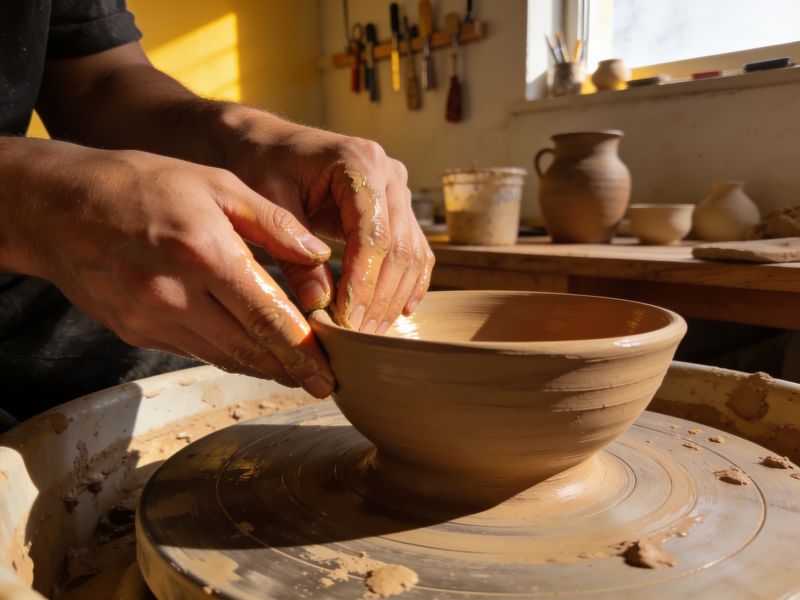
What sets Anna Catherine Vida apart is her refusal to scale. Major retailers have approached her twice;both times she declined. 'They wanted 5,000 identical mugs. I can't do identical. The kiln won't let me.' Instead, she produces roughly 600 pieces a year, sold through three small galleries and a waiting list that stretches to 18 months. Her bowls sell for £180;teapots for £650. Not cheap。but hardly predatory. A collector in Kyoto owns fourteen of her tea bowls. 'She understands that a bowl is a relationship,' he wrote to me. 'You don't own it. You use it until it knows you.'Vida's influence extends beyond her own output. Since 2010, she has run informal apprenticeships—no fees。
no contracts, just six months of showing up at 7 a.m. and wedging clay. Three former apprentices now run their own studios. 'She never told me what to make,' one recalled. 'She told me to look at my hands more than my sketches.' That philosophy—embodied knowledge over conceptual noise—has made her a quiet reference point for younger ceramicists tired of the design-blog circuit. You won't find her on a panel about 'craft in the digital age.' She's usually in the garden, collecting ash.I asked her what she wants her legacy to be. She laughed. 'Legacy is for people who stop working.' Then she picked up a rib and smoothed the rim of a jug, her thumb pressing just hard enough to leave a faint, deliberate mark. It's the kind of mark you only notice after months of daily use. That, perhaps, is the truest measure of Anna Catherine Vida's work: it rewards attention。not applause.